|
|

Table Of Contents
Web Cache Communication Protocol Version 2
Redirection for Multiple TCP Port-Destined Traffic
Load-Distributing Applications
Client IP Address Transparency
Supported Standards, MIBs, and RFCs
Configuring a Service Group Using WCCP Version 2
Running the Reverse Proxy Service
Running a Custom Web Cache Service
Registering a Router to a Multicast Address
Informing a Router of Valid IP Addresses
Setting a Password for a Router and Cache Engines
Disabling Caching for Certain Clients
Verifying WCCP Configuration Settings
Monitoring and Maintaining Using WCCP Version 2
Performing a General WCCP Version 2 Configuration
Running the Reverse Proxy Service
Running the Custom Web Cache Service
Registering a Router to a Multicast Address
Informing a Router of Valid IP Addresses
Setting a Password for a Router and Cache Engines
Bypassing the Cache Engine with Router Access Lists
Web Cache Communication Protocol Version 2
This appendix describes the Web Cache Communication Protocol (WCCP) Version 2 feature. It includes information on the benefits of this feature, supported platforms, and other information you may need to work with WCCP Version 2. This appendix includes the following sections:
•
Supported Standards, MIBs, and RFCs
•
Feature Overview
The Web Cache Communication Protocol (WCCP) feature allows you to use a Cache Engine to handle web traffic, reducing transmission costs and downloading time. This traffic includes user requests to view pages and graphics on
World Wide Web servers, whether internal or external to your network, and the replies to those requests. When a user requests a page from a web server (located on the Internet), the router sends the request to a Cache Engine. If the Cache Engine has a copy of the requested page in storage, the Cache Engine sends the user that page. Otherwise, the Cache Engine retrieves the requested page and the objects on that page from the web server, stores a copy of the page and its objects, and forwards the page and objects to the user.WCCP transparently redirects Hypertext Transfer Protocol (HTTP) requests going to the intended server to a Cache Engine. End users do not know that the page came from the Cache Engine rather than from the originally requested web server.
WCCP Version 2 contains the following new features:
•
•
•
•
•
•
Multirouter Support
WCCP Version 2 enables a series of Cache Engines, called a Cache Engine cluster, to connect to multiple routers. This feature provides redundancy and a more distributed architecture for instances when a Cache Engine needs to connect to a large number of interfaces. This strategy also has the benefit of keeping all the Cache Engines in a single cluster, avoiding unnecessary duplication of web pages across several clusters.
How Version 1 Works
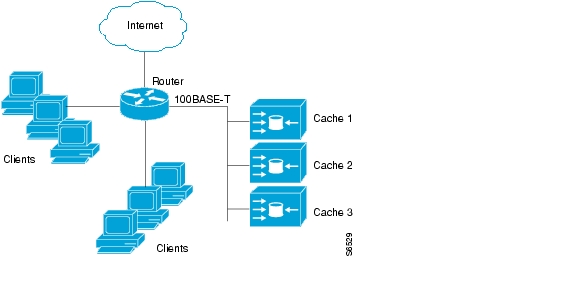
With WCCP Version 1, only a single router services a cluster, becoming the default home router for the cluster. In this scenario, this router is the device that performs all the IP packet redirection. Figure C-1 illustrates how this configuration appears.
Figure C-1 Cache Engine Network Configuration Using WCCP Version 1
The following sequence of events details how this process works:
1.
2.
3.
4.
How Version 2 Works
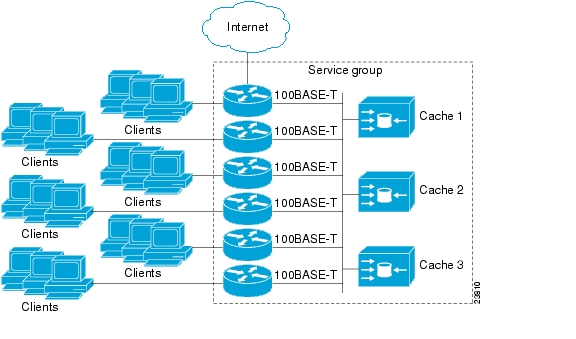
With WCCP Version 2, multiple routers can service a cluster. This allows any of the available routers in a service group to redirect packets to each of the Cache Engines in the cluster. Figure C-2 illustrates how this configuration appears.
Figure C-2 Cache Engine Network Configuration Using WCCP Version 2
You can configure the router to run one of three services:
•
•
•
The subset of Cache Engines within a cluster and routers connected to the cluster that are running the same service is known as a service group.
WCCP Version 2 addresses the issue of multiple routers being available to the cluster by allowing either a list of routers or an IP multicast address to be created on the Cache Engine. The difference in these two strategies is as follows:
•
•
If you are adding and removing routers dynamically, the multicast address strategy provides for easier configuration because you do not need to change the configuration for each device in the WCCP network.
The following sequence of events details how this process works:
1.
2.
3.
Cache Engine is designated the lead and sets the policy that the routers need to deploy in redirecting packets.Also, you must perform these tasks to configure the routers that will become members of the service group:
•
•
For network configurations in which the Cache Engine sends to a target router a packet that needs to traverse an intervening router, the router being traversed must be configured to perform IP multicast routing. You must configure two components to enable traversal over an intervening router:
•
•
How Routers and Cache Engines Communicate
Routers and Cache Engines become aware of one another and form a service group using a management protocol. Once the service group has been established, one of the Cache Engines is designated to determine load assignments among the Cache Engines.
If there is a group of Cache Engines, the one seen by all routers and the one that has the lowest IP address becomes the lead Cache Engine. The role of this
Cache Engine is to determine how traffic should be allocated across
Cache Engines. The assignment information is passed to the entire service group from the designated Cache Engine so that the routers of the group can redirect the packets properly and the Cache Engines of the group can manage their load better.Improved Security
WCCP Version 2 provides authentication that enables you to control which routers and Cache Engines become part of the service group. You use passwords and the HMAC MD5 standard set by the ip wccp [password [0-7] password] command to control service group membership.
Faster Throughput
Cisco Express Forwarding (CEF) has been integrated into WCCP Version 2 and provides fast packet redirection.
Redirection for Multiple TCP Port-Destined Traffic
WCCP Version 2 enables more TCP ports to have traffic redirected to the
Cache Engine. Previously, web-cached information could be redirected only if it was destined for TCP port 80. Many applications require packets intended for other ports to be redirected, for example, proxy-web cache handling, FTP caching, FTP proxy handling, web caching for ports other than 80, and
RealAudio, video, and telephony applications.Packets that the Cache Engines do not service are tunneled back to the same router from which they were received. When a router receives a formerly redirected packet, it knows not to redirect it again.
The criteria for determining whether to redirect the traffic are:
•
•
•
•
•
Note that service information has been added to the protocol to indicate which service the WCCP messages refer to. This information is used to help verify that service group members are all using or providing the same service.
Web Cache Packet Return
WCCP Version 2 filters packets to determine which redirected packets have been returned from the Cache Engine and which ones have not. It does not redirect the ones that have been returned because the Cache Engine has determined that the packets should not be cached. WCCP Version 2 returns packets that the
Cache Engine does not service to the same router from which they were transmitted. Typical reasons why a Cache Engine would reject packets and initiate packet return are:•
•
Load-Distributing Applications
WCCP Version 2 has the capability to adjust the load being offered to individual Cache Engines to provide more effective use of the resources available and at the same time help to ensure high quality of service to the clients. It uses three techniques to perform this task:
•
•
Cache Engine to other Cache Engines that have available capacity.•
Client IP Address Transparency
The Cache Engine accepts traffic and establishes the connection with the client, acting as if it were the original destination server. Once the connection is established, if the object being requested is not available on the Cache Engine, the engine then establishes its own connection out to the original destination server.
Restrictions
The following limitations apply to WCCP Version 2:
•
15 seconds or less.•
•
•
•
•
•
Related Documents
•
•
Supported Platforms
The following platforms are supported.
Supported Standards, MIBs, and RFCs
Standards
For descriptions of supported MIBs and how to use MIBs, see Cisco's MIB web site on CCO at http://www.cisco.com/public/sw-center/netmgmt/cmtk/mibs.shtml.
MIBs
None
RFCs
None
Prerequisites
Before you use WCCP Version 2, you must complete the following tasks:
•
•
Configuration Tasks
You can configure a router to run the web cache, custom web cache, and reverse proxy services associated with WCCP Version 2. The services can be configured simultaneously. Perform the following tasks to configure a cluster with multiple routers.
•
•
•
•
•
•
•
Configuring a Service Group Using WCCP Version 2
Running the Web Cache Service
Running the Reverse Proxy Service
Running a Custom Web Cache Service
Registering a Router to a Multicast Address
Informing a Router of Valid IP Addresses
Setting a Password for a Router and Cache Engines
Step 1
Router(config)# ip wccp web-cache password[0-7]passwordSets a password for the
Cache Engine that the router is trying to access.
Disabling Caching for Certain Clients
Verifying WCCP Configuration Settings
Step 1
A sample configuration follows:Console# show running-configBuilding configuration...Current configuration:!version 12.0service timestamps debug uptimeservice timestamps log uptimeno service password-encryptionservice udp-small-serversservice tcp-small-servers!hostname router4!enable secret 5 $1$nSVy$faliJsVQXVPW.KuCxZNTh1enable password alabama1!ip subnet-zeroip wccp web-cacheip wccp 99ip domain-name cisco.comip name-server 10.1.1.1ip name-server 10.1.1.2ip name-server 10.1.1.3!!!interface Ethernet0ip address 10.3.1.2 255.255.255.0no ip directed-broadcastip wccp web-cache redirect outip wccp 99 redirect outno ip route-cacheno ip mroute-cache!interface Ethernet1ip address 10.4.1.1 255.255.255.0no ip directed-broadcastip wccp 99 redirect outno ip route-cacheno ip mroute-cache!interface Serial0no ip addressno ip directed-broadcastno ip route-cacheno ip mroute-cacheshutdown!interface Serial1no ip addressno ip directed-broadcastno ip route-cacheno ip mroute-cacheshutdown!ip default-gateway 10.3.1.1ip classlessip route 0.0.0.0 0.0.0.0 10.3.1.1no ip http server!!!line con 0transport input noneline aux 0transport input allline vty 0 4password alaska1login!endStep 2
Console# show ip wccpGlobal WCCP Information:Service Name: web-cache:Number of Cache Engines:1Number of Routers:1Total Packets Redirected:213Redirect access-list:no_linuxTotal Packets Denied Redirect:88Total Packets Unassigned:-none-Group access-list:0Total Messages Denied to Group:0Total Authentication failures:0Service Name: 99Number of Cache Engines:1Number of Routers:2Total Packets Redirected:198Redirect access-list:-none-Total Packets Denied Redirect:0Total Packets Unassigned:0Group access-list:11Total Messages Denied to Group:0Total Authentication failures:0
Monitoring and Maintaining Using WCCP Version 2
Router# show ip wccpor
Router# show ip wccp {web-cache | 99}Displays global statistics related to WCCP.
Router#  show ip wccp {web-cache | 99}
detail
Queries the router for information about which
Cache Engines the router has detected in a specific service group. The information can be displayed for either a web cache or the reverse proxy service, which is indicated by a value of 99.Router# show ip interfaceShows whether any ip wccp direct commands are configured on an interface.
Router# show ip wccp {web-cache | 99}
view
Displays which devices in a particular service group have been detected and which Cache Engines are not visible to all other routers to which the current router is connected. The information can be displayed for either a web cache or the reverse proxy service, which is indicated by a value of 99.
Configuration Examples
This section provides the following configuration examples:
•
•
•
•
•
•
•
Performing a General WCCP Version 2 Configuration
The following example shows a general WCCP Version 2 configuration session:
ip wccp web-cache group-address 224.1.1.100 password alabama1interface ethernet0ip wccp web-cache redirect outRunning the Web Cache Service
The following example shows a web cache service configuration session:
configure terminalip wccp web-cacheinterface ethernet 0ip wccp web-cache redirect outRunning the Reverse Proxy Service
The following example shows a reverse proxy service configuration session:
configure terminalip wccp 99interface ethernet 0ip wccp 99 redirect outRunning the Custom Web Cache Service
The following example shows a custom web cache configuration session:
configure terminalip wccp 98interface ethernet 0ip wccp 98 redirect outRegistering a Router to a Multicast Address
The following example shows how to register a router to a multicast address of 192.168.0.0:
configure terminalip wccp web-cache group-address 192.168.0.0interface ethernet 0ip wccp web cache group-listenInforming a Router of Valid IP Addresses
To achieve better security, you can use a standard access list to notify the router which IP addresses are valid addresses for a Cache Engine attempting to register with the current router. The following example shows a standard access list configuration session where the access list number is 10 for some sample hosts:
configure terminalaccess-list 10 permit host 11.1.1.1access-list 10 permit host 11.1.1.2access-list 10 permit host 11.1.1.3ip wccp web-cache group-list 10Setting a Password for a Router and Cache Engines
The following example shows a WCCP Version 2 password configuration session where the password is alabama2:
configure terminalip wccp web-cache password alabama2Bypassing the Cache Engine with Router Access Lists
The router can be configured with access lists to permit or deny redirection of traffic to the Cache Engine. In the following example, traffic conforming to the following criteria is not redirected by the router to the CE:
•
•
router# configure terminalrouter(config)# ip wccp web-cache redirect-list 120router(config)# access-list 120 deny ip host 10.1.1.1 anyrouter(config)# access-list 120 deny ip any host 10.255.1.1router(config)# access-list 120 permit ip any anyTraffic not explicitly permitted is implicitly denied redirection.
The access-list 120 permit ip any any command explicitly permits all traffic (from any source enroute to any destination) to be redirected to the Cache Engine. Because criteria matching occurs in the order by which the commands are entered, the global permit command is the last command entered. For further information on access lists see Cisco IOS documentation.Displaying WCCP Settings
The following example displays WCCP settings, using the show running-config command:
Console# show running-configBuilding configuration...Current configuration:!version 12.0service timestamps debug uptimeservice timestamps log uptimeno service password-encryptionservice udp-small-serversservice tcp-small-servers!hostname router4!enable secret 5 $1$nSVy$faliJsVQXVPW.KuCxZNTh1enable password alabama1!ip subnet-zeroip wccp web-cacheip wccp 99ip domain-name cisco.comip name-server 10.1.1.1ip name-server 10.1.1.2ip name-server 10.1.1.3!!!interface Ethernet0ip address 10.3.1.2 255.255.255.0no ip directed-broadcastip wccp web-cache redirect outip wccp 99 redirect outno ip route-cacheno ip mroute-cache!interface Ethernet1ip address 10.4.1.1 255.255.255.0no ip directed-broadcastip wccp 99 redirect outno ip route-cacheno ip mroute-cache!interface Serial0no ip addressno ip directed-broadcastno ip route-cacheno ip mroute-cacheshutdown!interface Serial1no ip addressno ip directed-broadcastno ip route-cacheno ip mroute-cacheshutdown!ip default-gateway 10.3.1.1ip classlessip route 0.0.0.0 0.0.0.0 10.3.1.1no ip http server!!!line con 0transport input noneline aux 0transport input allline vty 0 4password alaska1login!endCommand Reference
This section documents new or modified commands that configure the WCCP Version 2 feature.
•
In Cisco IOS Release 12.0(1)T or later, you can search and filter the output for show and more commands. This functionality is useful when you need to sort through large amounts of output, or if you want to exclude output that you do not need to see.
To use this functionality, enter a show or more command followed by the "pipe" character (|), one of the keywords begin, include, or exclude, and an expression that you want to search or filter on:
command | {begin | include | exclude} regular-expression
Following is an example of the show atm vc command in which you want the command output to begin with the first line where the expression "PeakRate" appears:
show atm vc | begin PeakRate
For more information on the search and filter functionality, refer to the Cisco IOS Release 12.0(1)T feature module titled CLI String Search.
clear ip wccp
To remove Web Cache Communication Protocol (WCCP) statistics maintained on the router either for a particular service or for all the services, use the clear ip wccp EXEC command.
clear ip wccp {web-cache | service-number}
Syntax Description
Defaults
No default behavior or values.
Command Modes
EXEC
Command History
11.1 CA
This command was introduced.
11.2 P
This command was introduced.
12.0(3)T
This command has been expanded to be explicit about service.
Usage Guidelines
Use the show ip wccp and show ip wccp detail commands to display WCCP statistics.
Example
clear ip wccp web cacheRelated Commands
ip wccp
Directs a router to enable or disable the support for a service group.
show ip wccp
Displays global statistics related to the WCCP feature.
ip wccp
To direct a router to enable or disable the support for a Cache Engine service group, use the ip wccp global configuration command. To remove the ability of a router to control support for a service group, use the no form of this command.
ip wccp {web-cache | service-number} [group-address groupaddress] [redirect-list access-list] [group-list access-list] [password [0-7] password]
no ip wccp {web-cache | service-number} [group-address groupaddress] [redirect-list access-list] [group-list access-list] [password [0-7] password]
Syntax Description
Defaults
This command is disabled by default.
Command Modes
Global configuration
Command History
Example
The following example shows a router configured to run WCCP reverse proxy service, using (listening to) the multicast address of 192.168.0.0:
ip wccp 99 group-address 192.168.0.0Related Commands
ip wccp group-listen
Configures an interface on a router to enable or disable the reception of IP multicast packets for the WCCP feature.
ip wccp group-listen
To configure an interface on a router to enable or disable the reception of IP multicast packets for the Web Cache Communication Protocol (WCCP) feature, use the ip wccp group-listen interface configuration command. To remove control of the reception of IP multicast packets for the WCCP feature, use the no form of this command.
ip wccp {web-cache | service-number} group-listen
no ip wccp {web-cache | service-number} group-listen
Syntax Description
Defaults
This command is disabled by default.
Command Modes
Interface configuration
Command History
Example
The following example shows that multicast packets have been enabled for a web cache with an address of 192.168.0.0.
configure terminalip wccp web-cache group-address 192.168.0.0interface ethernet 0ip wccp web cache group-listenRelated Commands
ip wccp redirect exclude in
To configure an interface to enable or disable excluding packets received on an interface from being redirected to a Cache Engine, use the ip wccp redirect exclude in interface configuration command. To disable a router's ability to verify that only appropriate packets are being redirected to a Cache Engine, use the no form of this command.
ip wccp redirect exclude in
no ip wccp redirect exclude in
Syntax Description
This command has no arguments or keywords.
Defaults
No default behavior or values.
Command Modes
Interface configuration
Command History
Usage Guidelines
Note that the command is global to all the services and should be applied to any inbound interface that has been configured to be excluded from redirection on an outbound interface that the traffic will traverse.
Example
configure terminalip wccp 99interface ethernet0ip wccp redirect exclude inRelated Commands
ip wccp redirect out
To configure an interface to enable a router's ability to verify that appropriate packets are being redirected to a Cache Engine, use the ip wccp redirect out interface configuration command. To disable a router's ability to verify that only appropriate packets being redirected to a Cache Engine, use the no form of this command.
ip wccp {web-cache | service-number} redirect out
no ip wccp {web-cache | service-number} redirect out
Syntax Description
Defaults
No default behavior or values.
Command Modes
Interface configuration
Command History
Example
configure terminalip wccp 99interface ethernet0ip wccp 99 redirect outRelated Commands
ip wccp redirect exclude in
Configures an interface to enable or disable excluding packets received on an interface from being cached.
ip wccp version
To configure the WCCP version number, use the ip wccp version global configuration command. The default WCCP version is Version 2. Use this command to override the default.
ip wccp version {1 | 2}
Syntax Description
Defaults
No default behavior or values.
Command Modes
Global configuration
Command History
Example
ip wccp version 1show ip interface
To display status about any ip wccp direct commands configured on an interface, use the show ip interface EXEC command.
show ip interface [type - number]
Syntax Description
Defaults
No default behavior or values.
Command Modes
EXEC
Command History
Usage Guidelines
The Cisco IOS software automatically enters a directly connected route in the routing table if the interface is usable. A usable interface is one through which the software can send and receive packets. If the software determines that an interface is not usable, it removes the directly connected routing entry from the routing table. Removing the entry allows the software to use dynamic routing protocols to determine backup routes to the network (if any).
If the interface can provide two-way communication, the line protocol is indicated to be up. If the interface hardware is usable, the interface is indicated to be up.
If you specify an optional interface type, you will see information on that specific interface only.
If you specify no optional arguments, you will see information on all the interfaces.
When an asynchronous interface is encapsulated with Point-to-Point Protocol (PPP) or Serial Line Internet Protocol (SLIP), IP fast switching is enabled. A show ip interface command on an asynchronous interface encapsulated with PPP or SLIP displays a message indicating that IP fast switching is enabled.
Example
The following example displays output from the show ip interface command, using the interface e3/0:
show ip interface e3/0Ethernet3/0 is upInternet address is 17.1.1.38/24Broadcast address is 255.255.255.255Address determined by non-volatile memoryMTU is 1500 bytesHelper address is not setDirected broadcast forwarding is enabledOutgoing access list is not setInbound access list is not setProxy ARP is enabledSecurity level is defaultSplit horizon is enabledICMP redirects are always sentICMP unreachables are always sentICMP mask replies are never sentIP fast switching is enabledIP fast switching on the same interface is disabledIP Optimum switching is enabledIP multicast fast switching is enabledRouter Discovery is disabledIP output packet accounting is disabledIP access violation accounting is disabledTCP/IP header compression is disabledProbe proxy name replies are disabledGateway Discovery is disabledPolicy routing is disabledNetwork address translation is disabledWCCP Redirect outbound is enabledWCCP Redirect exclude is disabledTable C-2 describes the fields shown in the example.
Related Commands
show ip wccp
Displays global statistics related to the Web Cache Communication Protocol feature.
show ip wccp
To display global statistics related to the Web Cache Communication Protocol (WCCP) feature, use the show ip wccp EXEC command.
show ip wccp {web-cache | service-number} [view | detail]
Syntax Description
Defaults
No default behavior or values.
Command Modes
EXEC
Command History
Usage Guidelines
Use the clear ip wccp command to reset the counter for the "Packets Redirected" information.
Examples
The following example displays output from the show ip wccp command:
show ip wccpGlobal WCCP Information:Service Name: web-cache:Number of Cache Engines:1Number of Routers:1Total Packets Redirected:213Redirect access-list: no_linuxTotal Packets Denied Redirect:88Total Packets Unassigned:-none-Group access-list:0Total Messages Denied to Group:0Total Authentication failures:0Service Name: 1Number of Cache Engines:1Number of Routers:2Total Packets Redirected:198Redirect access-list:-none-Total Packets Denied Redirect:0Total Packets Unassigned:0Group access-list:11Total Messages Denied to Group:0Total Authentication failures:0Table C-3 describes the fields shown in the example.
The following example displays output from the show ip wccp web-cache detail EXEC command. This command displays Cache Engine and WCCP router statistics for a particular service group:
show ip wccp web-cache detailWCCP Router information:IP Address 192.168.88.10Protocol Version: 2.0WCCP Cache-Engine InformationIP Address: 192.168.88.11Protocol Version: 2.0State: UsableInitial Hash Info: AAAAAAAAAAAAAAAAAAAAAAAAAAAAAAAAAAAAAAAAAAAAAAAAAAAAAssigned Hash Info: FFFFFFFFFFFFFFFFFFFFFFFFFFFFFFFFFFFFFFFFFFFFFFFFFFFFHash Allotment: 256 (100.00%)Packets Redirected: 21345Connect Time: 00:13:46Table C-4 describes the fields shown in the example.
The following is sample output from the show ip wccp view EXEC command. In this case, the service number 1 has been specified.
show ip wccp service 1 viewWCCP Router Informed of:192.168.88.10192.168.88.20WCCP Cache Engines Visible192.168.88.11192.168.88.12WCCP Cache Engines Not Visible:-none-If any Cache Engine is displayed under the WCCP Cache Engines Not Visible field, the Cache Engine needs to be reconfigured to add this router to it. Table C-5 describes the fields shown in the example.
Related Commands
ip wccp detail
Directs a router to enable or disable the support for a service group.
Posted: Wed Aug 25 16:38:10 PDT 2004
All contents are Copyright © 1992--2004 Cisco Systems, Inc. All rights reserved.
Important Notices and Privacy Statement.