11-6
Cisco IP Telephony Solution Reference Network Design
956662
Chapter 11 IP Phone Services
Integration Considerations
Failure Scenario 1: Connection Fails to Cisco CallManager Server
Redundancy in this case depends upon the functionality of the phone service as well as on how it is
configured. When a primary Cisco CallManager server fails, all of the phones re-home to the backup
Cisco CallManager server. However, the IP Phone configuration file downloaded from the TFTP server
retains the same URL settings from the primary Cisco CallManager server. Therefore, the URL settings
not dependent upon Cisco CallManager (such as URL Idle and URL Proxy) remain operational.
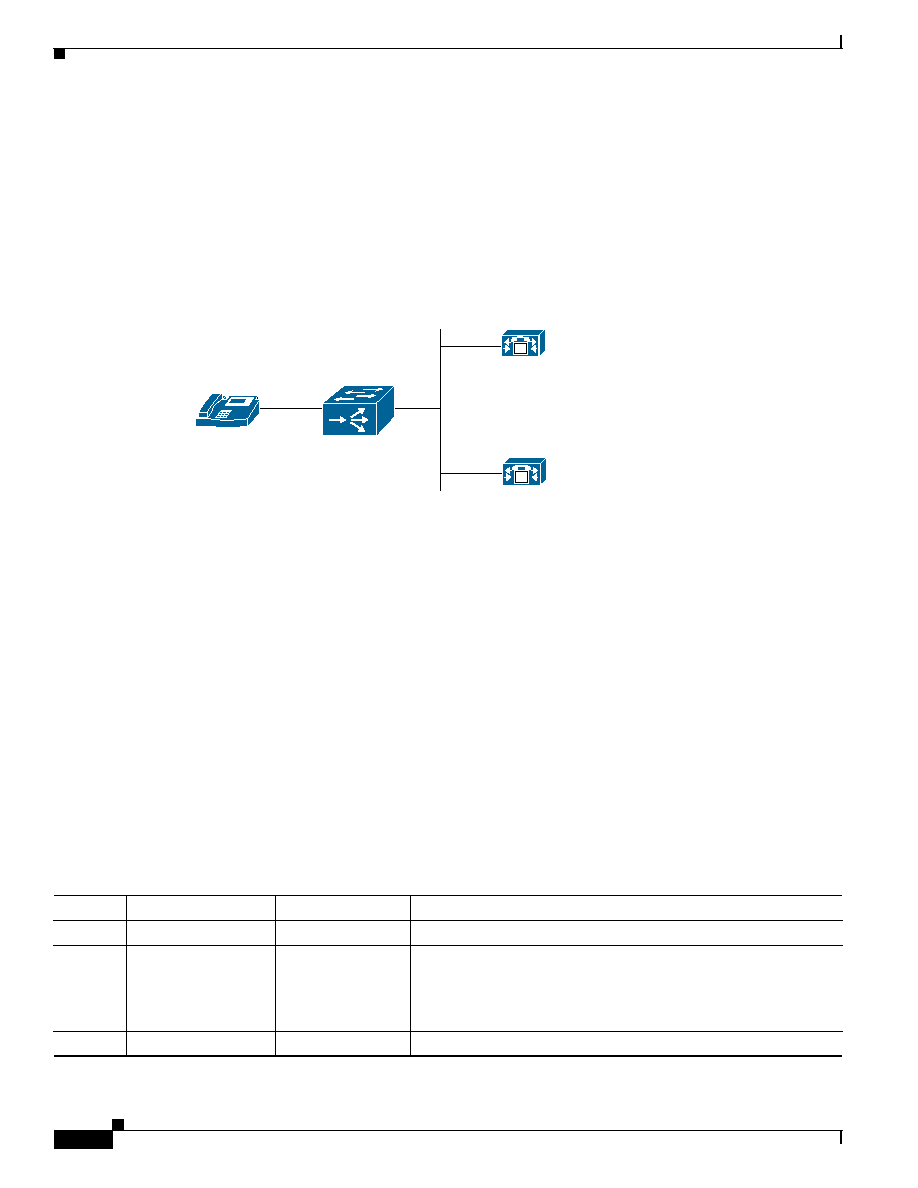
You can also provide redundancy by implementing server load balancing, either through
Cisco LocalDirector or Cisco IOS Server Load Balancing (SLB) on a Catalyst 6000. (See
Figure 11-4
Methods of Providing Redundancy for Phone Services
Failure Scenario 2: Connection Fails to Web Server Hosting the IP Phone Service
In this scenario, the connection to the Cisco CallManager server is preserved, but the link fails to the
web server hosting the user-subscribed phone service. This is an easier scenario to provision for
redundancy because the IP Phone is still able to access the Cisco CallManager server when the Services
button is pressed. In this case, the IP Phone is similar to any other HTTP client accessing a web server.
As a result, you can use any content distribution network (CDN) technology such as Server Load
Balancing (SLB) to redirect the HTTP request from the phone to a hot standby web server.
Quality of Service
IP packets from the IP Phone must be marked appropriately in order to have its traffic classified. For
priority queuing, Cisco recommends that the packets contain DSCP markings of AF31 and EF. (See
.)
87420
HTTP
IOS-SLB
(CAT6K)
VIP Address
172.26.1.1
CCM-1
Real Address
172.26.1.100
CCM-BK
Real Address
172.26.1.101
IP
M
M
Table 11-4
Traffic Classification for IP Phone Services
Protocol
Port
DSCP Marking
Comments
SCCP
TCP 2000
AF31, EF
Call control
RTP
UDP 20480-32768
AF31, EF
Automatically set if Cisco CallManager initiates RTP streaming
between two IP Phones.
Not set if RTP streaming is initiated by an IP Phone service;
therefore, traffic must be marked by the application.
HTTP
TCP 80
None by default
Traffic must be marked by the application.