Summary
375
shared tree. If there is another router with active members connected to the
router requesting the prune, it is removed from the outgoing interface list
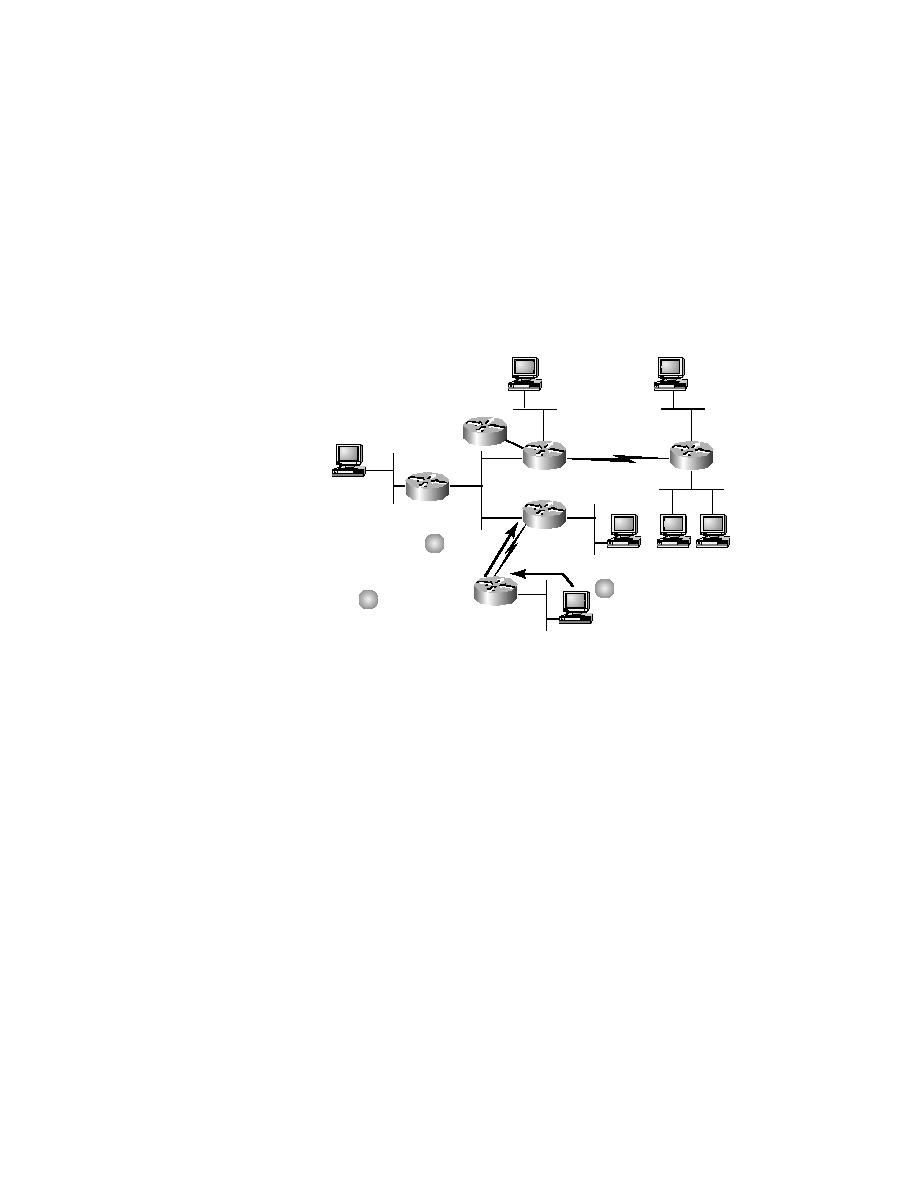
and no additional Prune messages are sent to the RP. See Figure 9.21 for a
visual description.
F I G U R E 9 . 2 1
PIM SM pruning
Router5 receives an IGMP message requesting the removal of HostG
from the group. Because HostG was the last active member of the group, the
(*, G) entry is set to null 0 and a prune request is sent by Router5 to Router3.
When Router3 receives the request, it removes the link for interface S0 from
the forwarding table. Because HostF is a directly connected active member of the
group, the entry for (*, G) is not null 0, so no prune request is sent to Router2
(the RP for this example).
If HostF were not active, the entry for (*, G) would have been set to null
0 also and a prune request would have been sent to the RP.
Summary
I
n this chapter, we described the many different facets of IP multicast.
We started out with an overview of multicast and compared it with unicast
HostA
HostF
HostB
HostC
HostD HostE
Member
224.2.125.125
Member
224.2.125.125
Router1
Router2
RP
Router3
HostG
Router5
Router4
Prune
request
IGMP remove request
E0 removed from
forwarding cache
3
1
2
E0
S0
Copyright ©2000 SYBEX , Inc., Alameda, CA
www.sybex.com