268
Chapter 7
Multi-Layer Switching (MLS)
MLSP Discovery
Switches, NFFCs or PFCs specifically, need routers to perform the initial
route table lookup and the packet rewrite. This dependency requires that
MLS adjacencies are established between the switch and the router. This is
accomplished using the MLSP protocol.
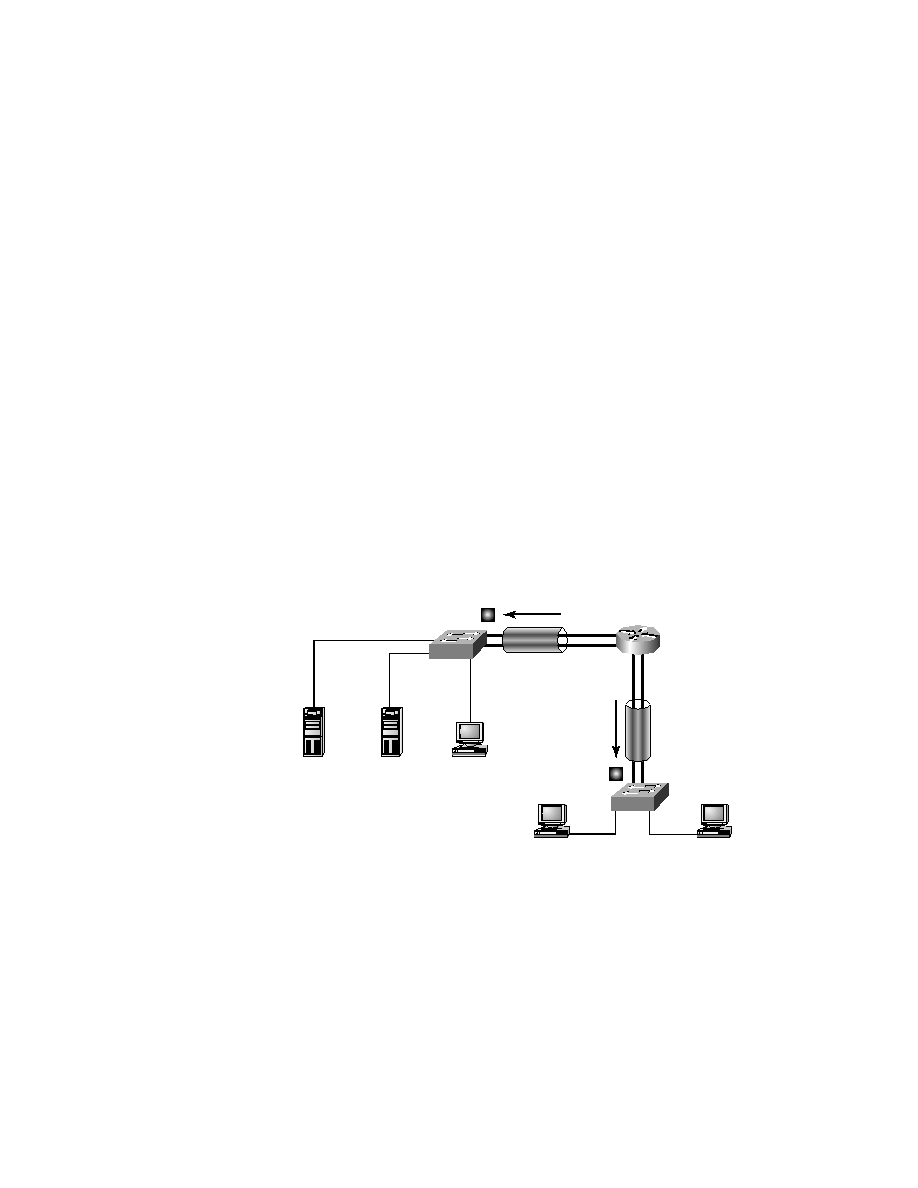
Initially, the router, or MLS-RP, sends hello packets containing all of the
MAC addresses and VLANs configured for use on the router. These mes-
sages are sent every 15 seconds to a layer 2 multicast address of 01-00-0C-
DD-DD-DD. The intended recipients of these hello packets are the MLS-SE
devices on the network.
When an MLS-SE receives the information, it makes an entry in the CAM
table of all the MLS-RP devices in the layer 2 network. Layer 2 is mentioned
because MLS-SE devices are not concerned with devices that are not directly
connected to layer 2 devices, such as switches. Figure 7.3 depicts the MLSP
discovery process.
F I G U R E 7 . 3
MLSP discovery
Part of the information that is stored in the CAM table once an MLSP
hello packet is received is an ID called an XTAG. The next section describes
the significance and purpose of the XTAG.
VLAN3
VLAN10
VLAN50
VLAN2
FE0/0.3
FE1/0.10
FE0/0
FE1/0
FE1/0.50
FE0/0.2
MLSP
Hello
Packet
MLSP
hello
packet
VLAN50
HostA
HostX
HostD
ServerB
ServerA
Copyright ©2000 SYBEX , Inc., Alameda, CA
www.sybex.com