Fundamentals of MLS
267
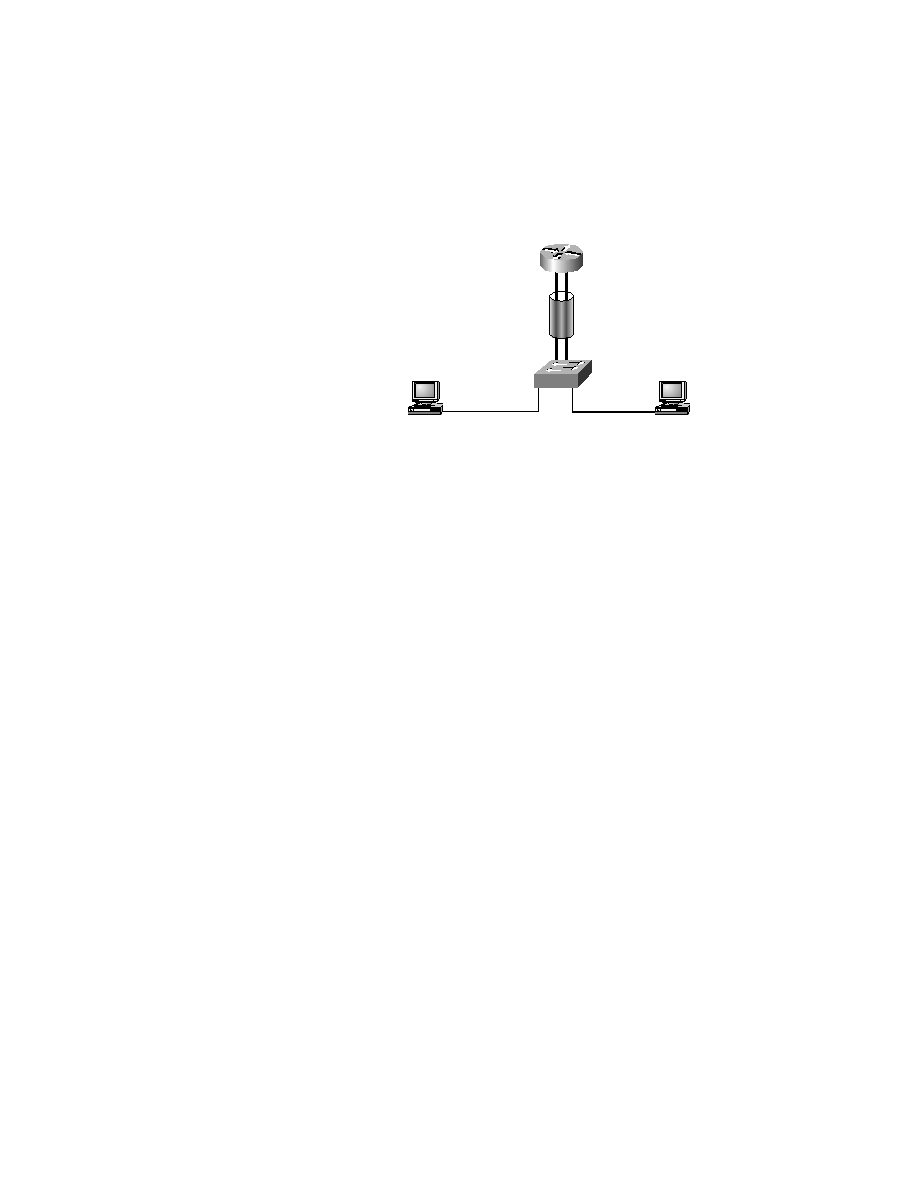
F I G U R E 7 . 2
MLS example topology
MLS follows a four-step process to establish the layer 3 switching func-
tionality. These four steps can then be broken down into more detailed pro-
cesses. The four steps required to enable MLS are as follows:
MLSP discovery The MLS-RP uses MLSP to send hello packets out all
interfaces to discover MLS-SE and establish MLS-RP/MLS-SE neighbor
relationships.
Identification of candidate packets The NFFC or PFC watches incom-
ing packets and creates partial cache entries for them, thus identifying the
packets as potential candidates for a flow, or candidate packets.
Identification of enable packets The NFFC or PFC watches packets
coming from the MLS-RP and tries to match them with candidate packet
entries. If matches are made, the packets are tagged as enable packets and
a shortcut forwarding entry is made in the CAM table.
Subsequent flow packets are layer 3 switched Incoming packets are
compared against CAM table entries. If the packets match the flow crite-
ria, they are rewritten by the NFFC or PFC, then sent to the corresponding
exit port for the flow.
The preceding list is an overview of the steps that must take place before
packets can be switched at layer 3. We'll discuss each step in detail in the fol-
lowing sections.
VLAN3
VLAN2
FE0/0.3
FE0/0.2
Copyright ©2000 SYBEX , Inc., Alameda, CA
www.sybex.com