Fundamentals of MLS
265
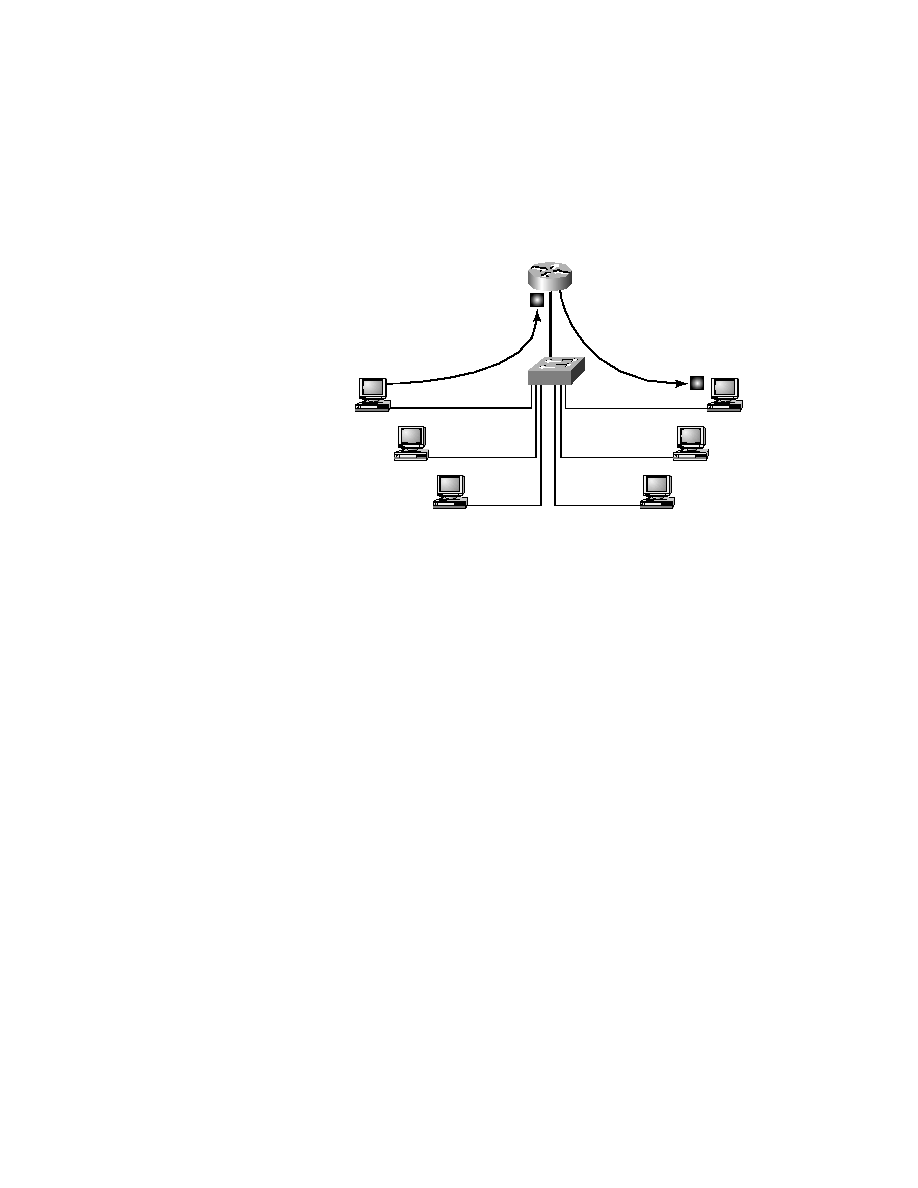
F I G U R E 7 . 1
Router on a stick diagram
By now you understand that for HostA on VLAN10 to communicate to
HostD on VLAN50, packets must be routed through RouterA. Because of
the VLAN assignments, the switch must send the packet to the router on
interface FE0/0.10. The router knows that the route to the network assigned
to VLAN50 is through interface FE0/0.50. The packet is then sent back to
the switch and forwarded to Host D.
Now back to our original question. Why use MLS? You can see from the
diagram in Figure 7.1 that it very inefficient to have to use a router, or Route
Switch Module (RSM), to move a packet from HostA to HostD when they
are connected to the same device. MLS is used to bypass the router on sub-
sequent packets of the same flow. A flow is created by using packet header
information--Inter-Switch Link (ISL), layer 2, and layer 3 headers. There are
several fields within a packet that make it unique:
Source and destination IP addresses
Source and destination MAC addresses
Type of Service (TOS)
Protocol type (i.e., HTTP, FTP, ICMP, etc.)
These are just some of the characteristics of a packet that can be used to
establish a flow. A flow is defined by using a specified set of these attributes.
VLAN10
VLAN50
VLAN10
VLAN50
VLAN10
VLAN50
Switch1
1/1
FE0/0.10
FE0/0.50
RouterA
HostA
HostB
HostC
HostD
HostE
HostF
Copyright ©2000 SYBEX , Inc., Alameda, CA
www.sybex.com