162
Chapter 4
Layer 2 Switching and the Spanning Tree Protocol (STP)
The time it usually takes to go from blocking to forwarding state is 50 sec-
onds. Changing the default STP timers is not recommended, but the timers
can be adjusted if they need to be. The time it takes to transition a port from
the listening state to the learning state or from the learning state to the for-
warding state is called the forward delay.
Spanning Tree Example
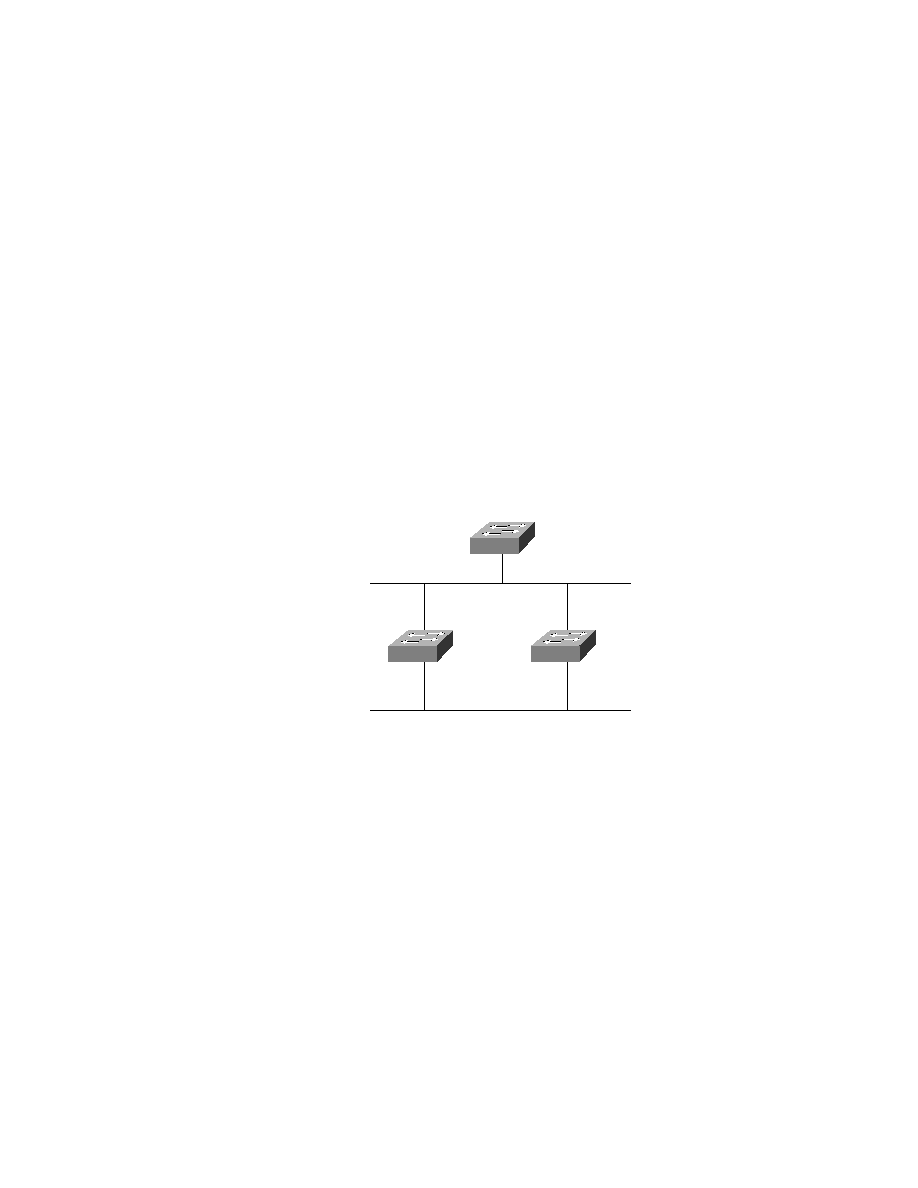
In Figure 4.6, the three switches all have the same priority of 32768. How-
ever, notice the MAC address of each switch. By looking at the priority and
MAC addresses of each switch, you should be able to determine the root
bridge.
F I G U R E 4 . 6
Spanning tree example
Because 1900A has the lowest MAC address and all three switches use the
default priority, 1900A will be the root bridge.
To determine the root ports on switches 1900B and 1900C, you need to
look at the cost of the link connecting the switches. Because the connection
from both switches to the root switch is from port 0 using a 100Mbps link,
that has the best cost and both switches' root port will then be port 0.
Use the bridge ID to determine the designated ports on the switches. The
root bridge always has all ports as designated. However, because both
1900B and 1900C have the same cost to the root bridge, the designated port
will be on switch 1900B because it has the lowest bridge ID. Because 1900B
100BaseT
10BaseT
Root port (F)
Designated port (F)
Designated port (F)
Root port (F)
Nondesignated port (BLK)
Port 0
Port 0
Port 1
Port 0
Port 1
Nonroot bridge
Nonroot bridge
1900A
MAC 0c00c8110000
Default priority 32768
1900C
MAC 0c00c8222222
Default priority 32768
1900B
MAC 0c00c8111111
Default priority 32768
Copyright ©2000 SYBEX , Inc., Alameda, CA
www.sybex.com