1-5
Cisco IP Telephony Solution Reference Network Design
956662
Chapter 1 IP Telephony Deployment Models
Multi-Site WAN with Centralized Call Processing
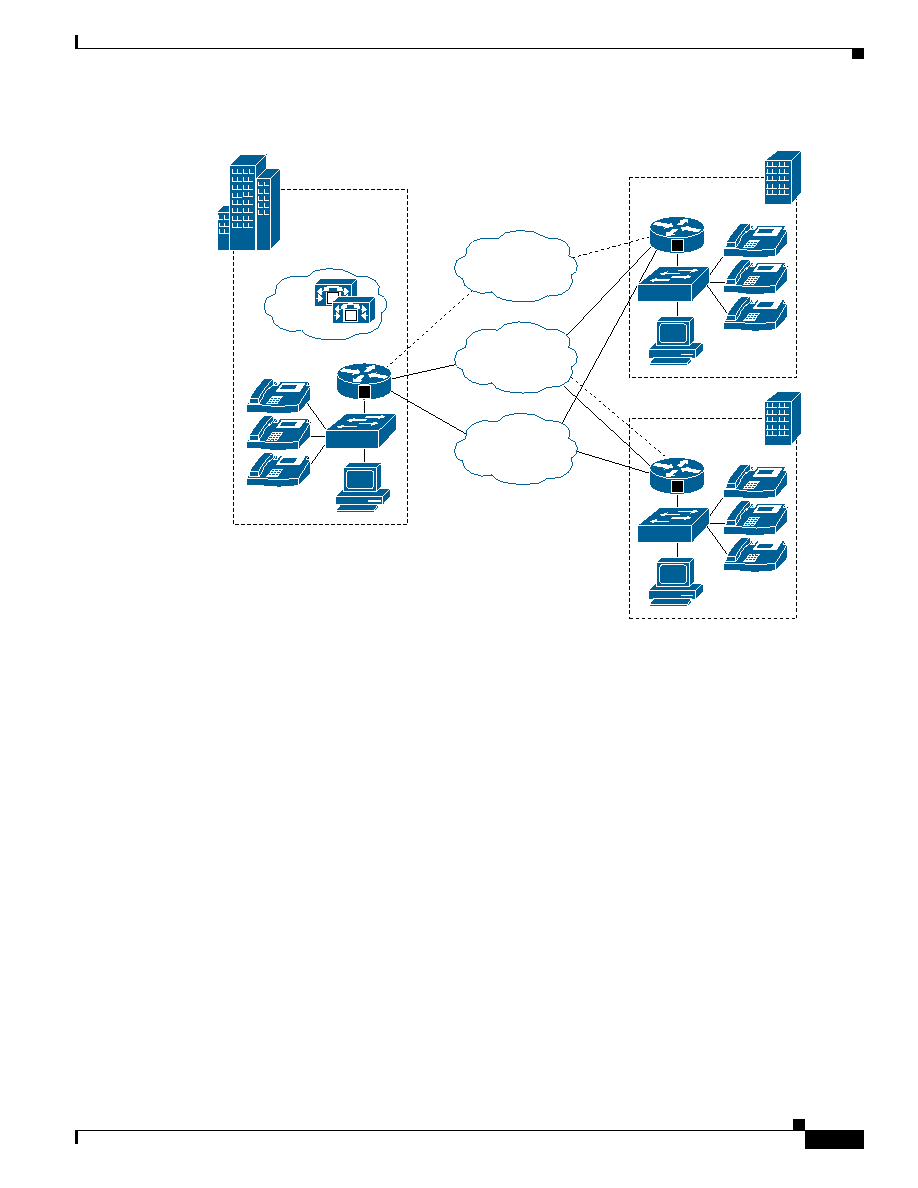
Figure 1-2
Centralized Call Processing Deployment Model
Connectivity options for the IP WAN include:
·
Leased lines
·
Frame Relay
·
Asynchronous Transfer Mode (ATM)
·
ATM and Frame Relay Service Inter-Working (SIW)
·
Multiprotocol Label Switching (MPLS) Virtual Private Network (VPN)
·
Voice and Video Enabled IP Security Protocol (IPSec) VPN (V3PN)
Routers that reside at the WAN edges require quality of service (QoS) mechanisms, such as priority
queuing and traffic shaping, to protect the voice traffic from the data traffic across the WAN, where
bandwidth is typically scarce. In addition, a call admission control scheme is needed to avoid
oversubscribing the WAN links with voice traffic and deteriorating the quality of established calls. For
centralized call processing deployments, the locations construct within Cisco CallManager provides call
admission control. (Refer to the section on
, for more information on locations.)
A variety of Cisco gateways can provide the remote sites with PSTN access. When the IP WAN is down,
or if all the available bandwidth on the IP WAN has been consumed, users at the remote sites can dial
the PSTN access code and place their calls through the PSTN. The Survivable Remote Site Telephony
(SRST) feature, available on Cisco IOS gateways, provides call processing at the branch offices in the
event of a WAN failure.
IP
IP
IP
IP
IP
IP
ISDN
backup
PSTN
IP WAN
Cluster
74352
M
M
V
V
IP
IP
IP
V
Central site
Branch offices