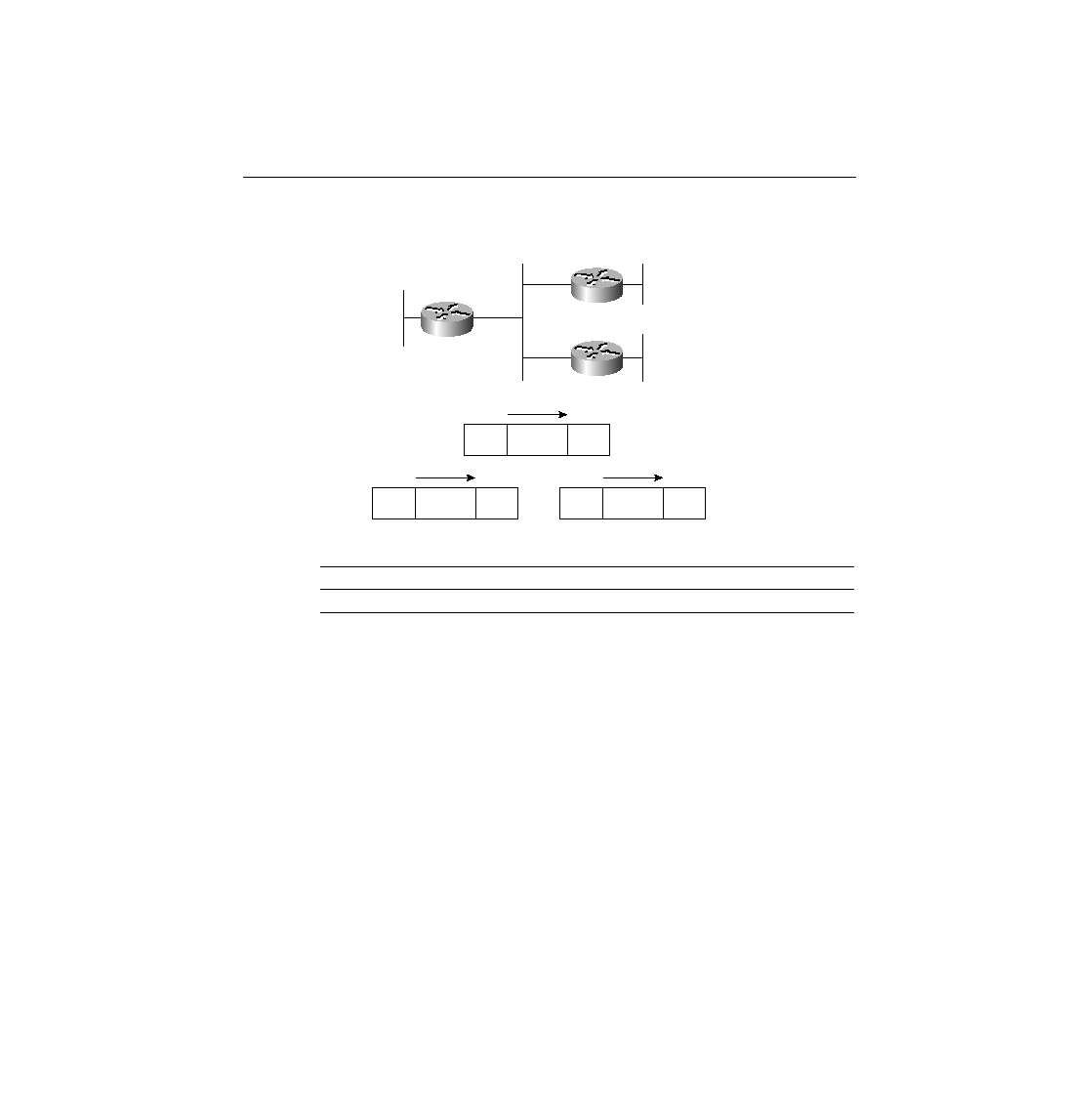
strips the Ethernet header (and trailer). Router A decides to route the packet out Ethernet 0 to
the next router, 10.1.2.2 (Router B's E1 IP address). Router A builds the new Ethernet header/
trailer and sends the frame.
10.1.2.2 (Router B's E1 IP address). The destination Ethernet address in the header built by
Router A is Router B's E1 address. Router A learns this information dynamically using the
IP ARP protocol. Similarly, with IPX routing, the next-hop router's IPX address has the
corresponding LAN address embedded in the IPX address. (With other Layer 3 protocols, there
are other processes on LANs for learning the corresponding LAN address.) The information
learned by IP ARP in this case is the information that maps the next-hop IP address to the LAN
address used to reach it; this is called mapping. A more general definition for mapping follows:
Layer 2 address used to reach it, is called mapping. Mapping is needed on
multiaccess networks.