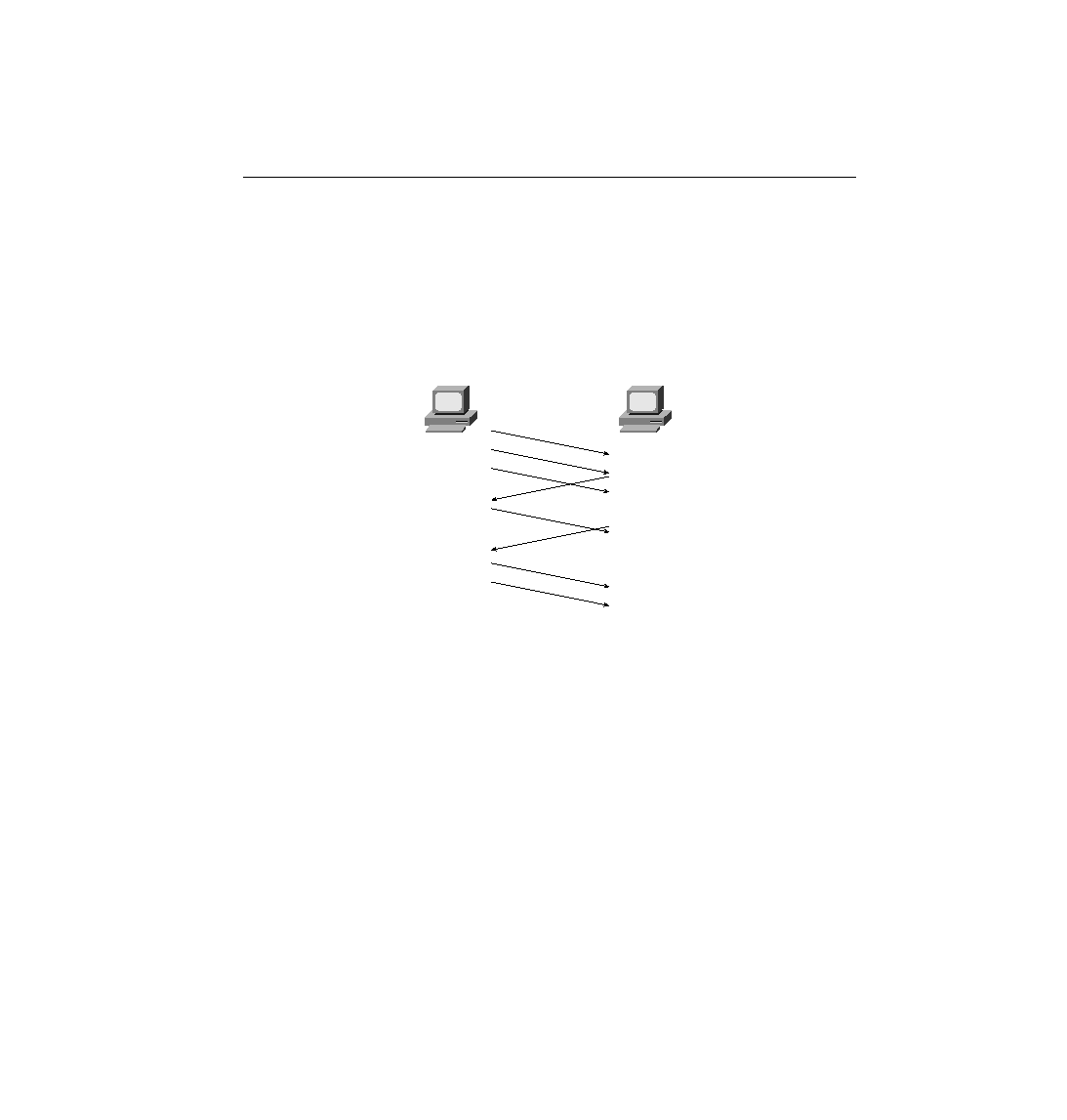
amount of data the sender can send without getting an acknowledgment. If no acknowledgment
is received by the time the window is filled, then the sender must wait for acknowledgment.
Figure 3-10 shows an example. The slanted lines indicate the time difference between sending
a PDU and its receipt.
receipt of frame 1, frame 4 can be sent. After a time lapse, the acknowledgment for frames 2
and 3 are received, which is signified by the frame sent by the receiver with the acknowl-
edgment field equal to 4. So, the sender is free to send two more frames--frames 5 and 6--
before another acknowledgment is received.
you really understand the technology rather than simply understanding how to pass a particular
exam. Focusing on understanding the concepts, as always, gives you a chance to get the exam
questions correct. Table 3-6 summarizes the flow control terms and provides examples of each
type. Memorizing these terms should help trigger your memory of flow-control concepts.